
| experiment | Number of participants |
|---|---|
| 1 | 1324 |
| 2 | 577 |
Data Analysis for the Paper
Preliminary Data Treatment
The first experiment was run on June 22, July 7 and August 31, 2021, using Amazon Mechanical Turk on a sample of a majority of USA residents. The experiment is hereafter labelled Experiment 1. The second experiment was run on Monday 14, 2023, using Prolific on a representative sample of 600 USA residents. The experiment is hereafter labelled Experiment 2.
We first load the anonymized cleaned data. We have removed from the original output of the data the Prolific and MTURK IDs, that are used for payments. We ensure therefore that the data is anonymous.
First, we load the data from the experiments. We add columns that describe treatments that were not present in the first experiments and align the names of the columns between the different experiments. There was no control for the lottery in the first two AMT experiments.
We load the data from the representative sample, with some renaming to make sure that columns bind together properly afterwards.
We treat age variables to make it consistent between the two experiments.
We bind the data together and simplify the criteria names.
We remove some treatments that we exclude from the analysis. As we have said in the pre-registration, we have removed participants who have not finished the experiment from the data in the cleaning process. We also remove the RPS loser and the arrival time procedures from the first experiment. The latter was formulated differently from the Time treatments later on (the time was not randomly given or chosen, but it was their arrival time).
Section: Experiment 1
Size of the Treatments (Table 1)
In total 1901 participants took part in the experiments.
| Non-lottery procedure | Control? | No | No | Yes |
|---|---|---|---|---|
| RPS | No | 140 | 152 | - |
| Yes | 99 | 98 | 291 | |
| Paintings | No | 114 | 123 | - |
| Yes | 89 | 97 | - | |
| Time | No | 91 | 106 | - |
| Yes | 113 | 102 | 286 | |
| Note: | ||||
| When yes for control, subjects chose the sequence used in the procedure. |
Earnings
| Experiment | Hourly Earnings | Min. | Sec. |
|---|---|---|---|
| 1 | $20.78 | 4 | 40.5 |
| 2 | $18.75 | 5 | 11.0 |
| Note: | |||
| There was a mistake in the configuration of the Prolific experiment. We show here what they would have earned without this mistake. In reality, the median hourly earnings are $32.75 . The time is the total time spent in Experiment 2 is from entering Prolific to leaving it, whereas it is only the time spent in the oTree part for Experiment 1. |
Table 3 shows the median time spent and hourly earnings in both experiments.
Non-Lottery vs Lottery (Figure 1)
Now we wonder what procedures subjects selected in the different treatments and experiments.
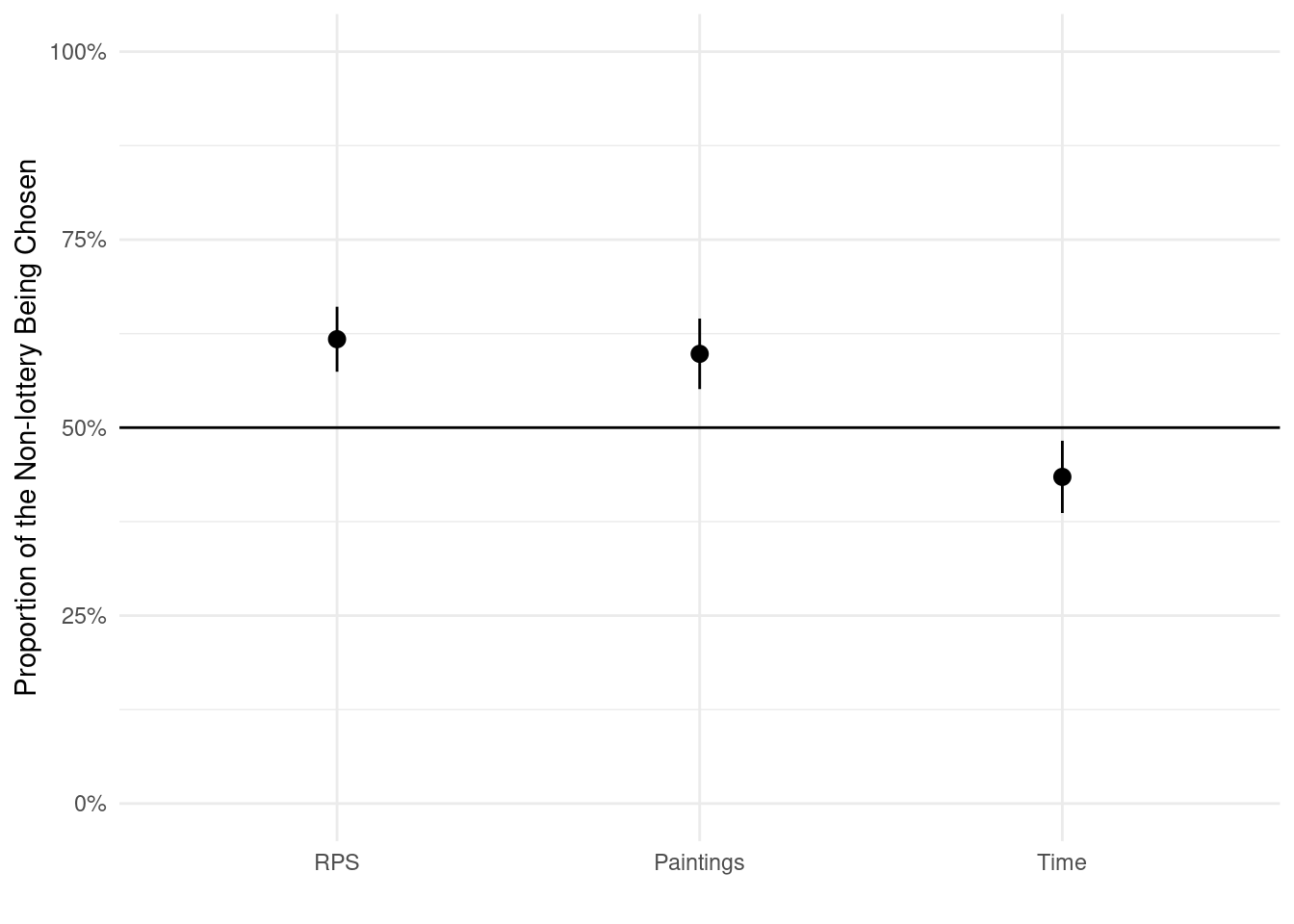
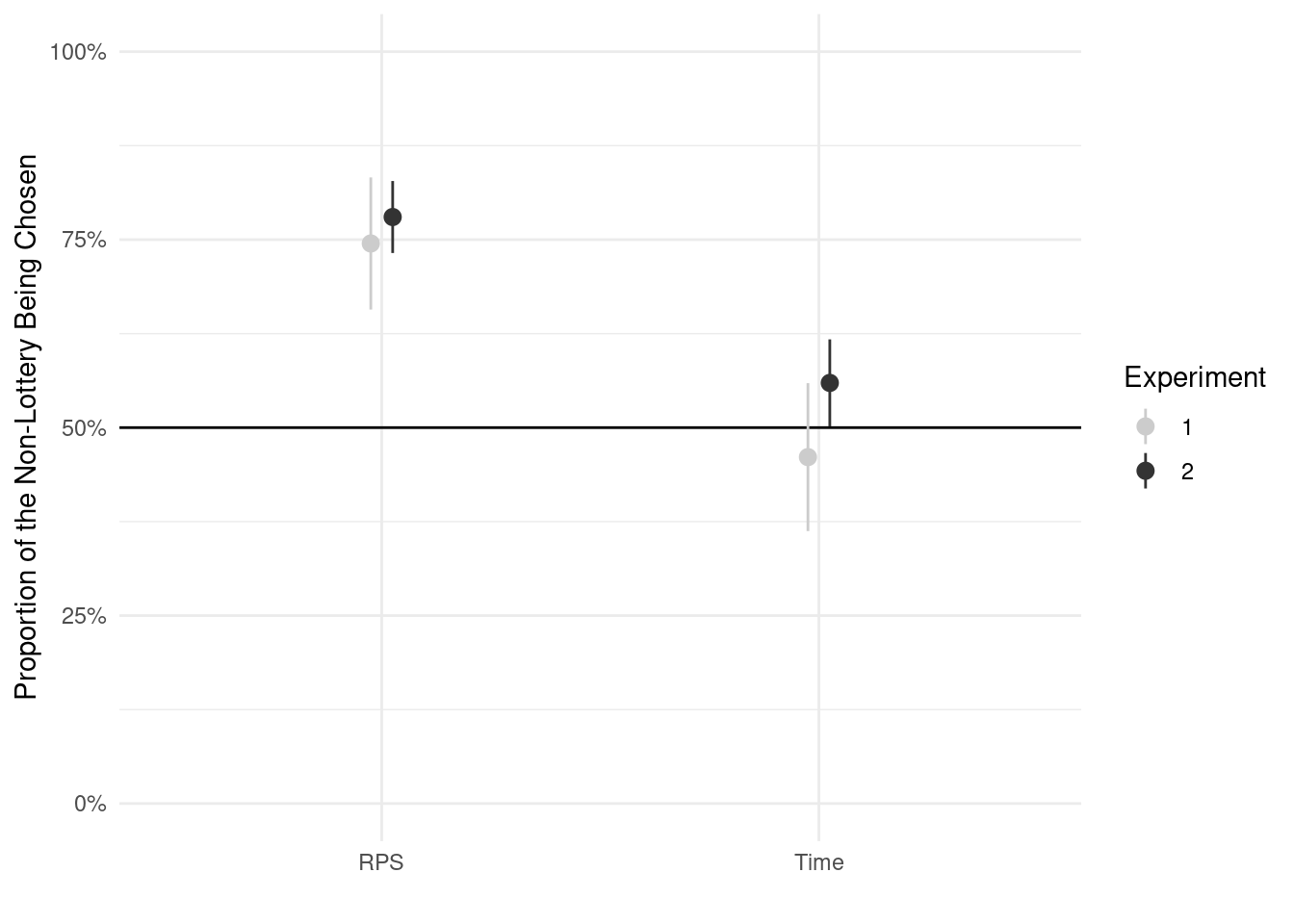
We give in Figure 1 the choices of subjects in Experiment 1, pooling togther all treatments. In Figure 2 we plot on the same results in Experiment 2 and compare them to the corresponding treatments of Experiment 1 (in grey). Table 7 shows that the difference between the two experiments, when in the same treatments, are not significant.
We run the first analysis with all subjects.
| Treatment | Experiment | Ritual Chosen | P-value^1^ |
|---|---|---|---|
| RPS | 1 | 61.8% | <0.001 |
| Paintings | 1 | 59.8% | <0.001 |
| Time | 1 | 43.4% | 0.008 |
| RPS | 2 | 78.0% | <0.001 |
| Time | 2 | 55.9% | 0.044 |
| 1 P-value of the one sample two-sided t-test of equality with 50%. |
Table 4 shows that in Experiment 1, RPS and Paintings are chosen significantly more than 50% of the time, whereas Time is chosen significantly. In Experiment 2, both RPS and Time are chosen significantly more than 50% of the time.
| Experiment | Lottery Chosen | RPS | Time | P-value |
|---|---|---|---|---|
| 1 | FALSE | 302 | 179 | <0.001 |
| 1 | TRUE | 187 | 233 | <0.001 |
| 2 | FALSE | 227 | 160 | <0.001 |
| 2 | TRUE | 64 | 126 | <0.001 |
Given the difference in the proportion between the RPS and Time rituals, we can nevertheless test if the proportions are equal or not. Table 5 shows that the proportion are significantly different: our participants chose RPS more often than Time in both experiments.
There is no significant difference in the choice of the non-random procedure comparing RPS and Paintings (the p-value of the Fisher test of the proportion of subjects choosing the non-random procedure being different is ).
Regression Analysis (Table 2)
| Non-Lottery Chosen | ||
|---|---|---|
| Simple | Controls | |
| (Intercept) | 0.695*** | 0.699*** |
| (0.032) | (0.078) | |
| Time | -0.190*** | -0.191*** |
| (0.033) | (0.033) | |
| Paintings | -0.028 | -0.024 |
| (0.032) | (0.032) | |
| Win only in Non-Lottery1 | 0.114*** | 0.112*** |
| (0.033) | (0.033) | |
| Win only in Lottery1 | -0.099** | -0.098** |
| (0.035) | (0.035) | |
| No Control on Non-Lottery | -0.053* | -0.050+ |
| (0.027) | (0.027) | |
| Control on Lottery | -0.103*** | -0.107*** |
| (0.027) | (0.027) | |
| Male | 0.052+ | |
| (0.027) | ||
| Age Controls2 | No | Yes |
| Num.Obs. | 1324 | 1317 |
| R2 | 0.059 | 0.065 |
| R2 Adj. | 0.055 | 0.058 |
| + p < 0.1, * p < 0.05, ** p < 0.01, *** p < 0.001 | ||
| 1 Win only in XX is a dummy for when a subjects believe they will win the XX procedure and NOT in the alternative one. | ||
| 2 Age controls: Control for the age categories, none are significant. | ||
Experiment 2 (Figure 2)
In Table 7, we show that in both experiments, the proportion of subjects choosing the non-lottery is significantly above 50% for RPS. For Time, the results differ between the two experiments. The result from Experiment 2, where Time is significantly more chosen that 50%, should be seen as more robust, as it is on a representative sample of the population.
| Procedure | Experiment | Proportion | P-value |
|---|---|---|---|
| RPS | 1 | 74.5% | <0.001 |
| RPS | 2 | 78.0% | <0.001 |
| Time | 1 | 46.1% | 0.431 |
| Time | 2 | 55.9% | 0.044 |
| Note: | |||
| P-value of the one sample two-sided t-test of the proportion being equal to 50%. |
| criteria | lottery_chosen | exp1 | exp2 | fisher_est | fisher_pval |
|---|---|---|---|---|---|
| RPS | FALSE | 73 | 227 | 0.8237051 | 0.489 |
| RPS | TRUE | 25 | 64 | 0.8237051 | 0.489 |
| Time | FALSE | 47 | 160 | 0.6736616 | 0.105 |
| Time | TRUE | 55 | 126 | 0.6736616 | 0.105 |
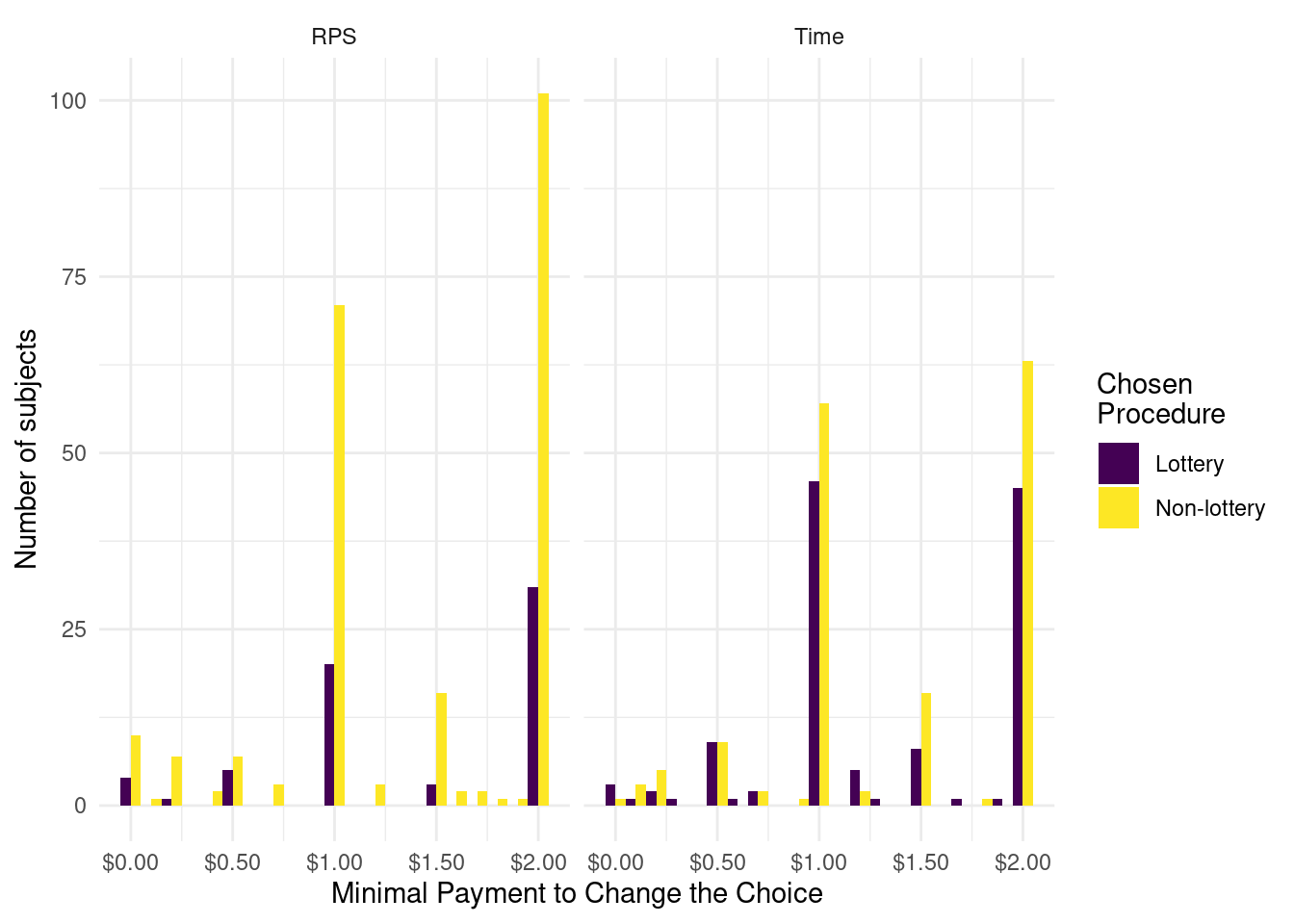
We have tried to get at the strength of preferences by asking the willingness to accept for their choice being removed. We find only 3.1% of subjects state indifference in Experiment 2 (by stating a WTA of $0). Table 9 shows that removing indifferent subject from the sample does not change the proportion chosen.
| criteria | lottery_chosen | not_strict | strict | fisher_est | fisher_pval |
|---|---|---|---|---|---|
| RPS | FALSE | 227 | 217 | 0.9807328 | >0.999 |
| RPS | TRUE | 64 | 60 | 0.9807328 | >0.999 |
| Time | FALSE | 160 | 159 | 0.9823565 | 0.933 |
| Time | TRUE | 126 | 123 | 0.9823565 | 0.933 |
Section 4: Robustness
Our Procedures Are Unpredictable (Table 3)
We know assess how well subjects predict their own future performance.
| Non random | Lottery |
|---|---|
| 0.006 (0.787) | -0.003 (0.911) |
| Procedure | Non-lottery | Lottery |
|---|---|---|
| Experiment 1 | ||
| RPS | 0.01 (0.825) | 0.035 (0.44) |
| Paintings | -0.031 (0.522) | -0.013 (0.783) |
| Time | -0.047 (0.344) | 0.033 (0.511) |
| Experiment 2 | ||
| RPS | 0.11 (0.061) | -0.032 (0.582) |
| Time | 0.036 (0.545) | -0.071 (0.234) |
| Note: | ||
| P-value of the correlation test of the correlation being equal to 0 in parenthesis. | ||
Rock, paper, scissors
We look at the choices in RPS, to check for the bias in favour or Rock.
| Rock | Paper | Scissors | Rock | Paper | Scissors |
|---|---|---|---|---|---|
| 37.5% | 34.8% | 27.7% | 44.7% | 35.6% | 19.6% |
Beliefs and Overconfidence (Table 4)
Table 13 shows some overall overconfidence, as more than 50% of subjects believe they will win in either the criteria or the lottery. To see if beliefs influence choices, we can look at the subjects who believe they will win in the criteria but not in the lottery and the reverse. If beliefs are the only driver of choices, then the first group should always choose the criteria, and the second group should always choose the lottery. Table 16 shows that it is not the case. P-value of the Fisher test shows that beliefs have only a minor influence as well.
| Experiment | Treatment | Winning in non-Lottert | Winning in Lottery |
|---|---|---|---|
| RPS | 1 | 60.7% | 59.5% |
| Paintings | 1 | 65.5% | 58.6% |
| Time | 1 | 58.3% | 55.8% |
| RPS | 2 | 72.5% | 56.0% |
| Time | 2 | 62.9% | 53.5% |
| Experiment | Non-Lottery Procedure | Belief | Non-Lottery | Lottery | P-value<sup>1</sup> |
|---|---|---|---|---|---|
| 1 | RPS | Win | 297 | 291 | 0.744 |
| 1 | RPS | Loose | 192 | 198 | 0.744 |
| 1 | Paintings | Win | 277 | 248 | 0.047 |
| 1 | Paintings | Loose | 146 | 175 | 0.047 |
| 1 | Time | Win | 240 | 230 | 0.527 |
| 1 | Time | Loose | 172 | 182 | 0.527 |
| 2 | RPS | Win | 211 | 163 | <0.001 |
| 2 | RPS | Loose | 80 | 128 | <0.001 |
| 2 | Time | Win | 180 | 153 | 0.027 |
| 2 | Time | Loose | 106 | 133 | 0.027 |
| 1 P-value of the Fisher exact test of the proportion of subjects stating that they will win in one procedure (non-lottery or lottery) being the same. |
| Experiment | Procedure | Non-random | Lottery | Non-random | Lottery | P-value<sup>1</sup> |
|---|---|---|---|---|---|---|
| 1 | RPS | FALSE | FALSE | 64.5% | 59.2% | 0.347 |
| 1 | RPS | FALSE | TRUE | 62.9% | 60.7% | 0.713 |
| 1 | RPS | TRUE | FALSE | 53.1% | 56.1% | 0.669 |
| 1 | RPS | TRUE | TRUE | 59.6% | 61.6% | 0.773 |
| 1 | Paintings | FALSE | FALSE | 71.5% | 64.2% | 0.221 |
| 1 | Paintings | FALSE | TRUE | 56.1% | 60.5% | 0.504 |
| 1 | Paintings | TRUE | FALSE | 64.9% | 50.5% | 0.042 |
| 1 | Paintings | TRUE | TRUE | 69.7% | 57.3% | 0.088 |
| 1 | Time | FALSE | FALSE | 55.7% | 49.1% | 0.338 |
| 1 | Time | FALSE | TRUE | 50.5% | 42.9% | 0.301 |
| 1 | Time | TRUE | FALSE | 65.7% | 69.6% | 0.552 |
| 1 | Time | TRUE | TRUE | 60.2% | 60.2% | >0.999 |
| 2 | RPS | TRUE | FALSE | 72.5% | 56.0% | <0.001 |
| 2 | Time | TRUE | FALSE | 62.9% | 53.5% | 0.022 |
| 1 P-value of the two-sided two-sample t-test of the proportion between the non-lottery procedure and the lottery being the same. |
| Non-lottery Procedure | Non-Lottery | Lottery | P-value^1^ |
|---|---|---|---|
| Experiment 1 | |||
| RPS | 79.1% | 46.2% | <0.001 |
| Paintings | 67.0% | 43.7% | 0.003 |
| Time | 50.6% | 45.3% | 0.530 |
| Experiment 2 | |||
| RPS | 84.9% | 63.2% | 0.010 |
| Time | 63.8% | 45.2% | 0.117 |
| Note: | |||
| The first column represents subjects expecting to win in the non-lottery procedure but not in the lottery, the second column the reverse. | |||
| 1 P-value of the Fisher test of the proportions of subjects who believe they will win in one procedure but not the other who choose the non-lottery procedure being equal. | |||
| Non-Lottery Procedure | Non-Lottery | Lottery | P-value^1^ |
|---|---|---|---|
| RPS | 85.4% | 66.7% | 0.026 |
| Time | 63.2% | 45.2% | 0.120 |
| Note: | |||
| The first column represents subjects expecting to win in the non-lottery procedure but not in the lottery, the second column the reverse. | |||
| 1 P-value of the Fisher test of the proportions of subjects who believe they will win in one procedure but not the other who choose the non-lottery procedure being equal. |
Appendix
Appendix A Experiment 1 (Table 5)
| Control | Lottery | Non-lottery | Lottery | Non-lottery | P-value |
|---|---|---|---|---|---|
| FALSE | 267 | 411 | 39.4% | 60.6% | <0.001 |
| TRUE | 323 | 323 | 50.0% | 50.0% | <0.001 |
| Note: | |||||
| P-value of the Fisher exact test of equal proportions. |
| Control | Lottery | Non-Lottery | Lottery | Non-Lottery | P-value |
|---|---|---|---|---|---|
| FALSE | 334 | 392 | 46.0% | 54.0% | 0.267 |
| TRUE | 256 | 342 | 42.8% | 57.2% | 0.267 |
| Note: | |||||
| P-value of the Fisher exact test of equal proportions. |
| Non-lottery Procedure | Control | Lottery | Non-lottery | Lottery | Non-lottery | P-value<sup>1</sup> |
|---|---|---|---|---|---|---|
| Rituals | FALSE | 222 | 307 | 42.0% | 58.0% | 0.046 |
| Rituals | TRUE | 135 | 248 | 35.2% | 64.8% | 0.046 |
| Time | FALSE | 112 | 85 | 56.9% | 43.1% | 0.921 |
| Time | TRUE | 121 | 94 | 56.3% | 43.7% | 0.921 |
| Note: | ||||||
| Rituals group together the RPS and Time procedures. | ||||||
| 1 P-value of the Fisher exact test of equal proportions. |
| Control in | ||||
| Non-Lottery | Yes | Yes | No | No |
| Lottery | No | Yes | No | Yes |
| Non-lottery procedure | ||||
| RPS | 74.5% | 58.6% | 65.1% | 51.4% |
| Paintings | 66.0% | 59.6% | 62.6% | 51.8% |
| Time | 46.1% | 41.6% | 48.1% | 37.4% |
| Note: | ||||
| Share over all subjects in their respective sample. | ||||
Appendix B Experiment 2 (Table 6)
| Non-Lottery Chosen | ||
|---|---|---|
| Simple | Controls | |
| (Intercept) | 0.780*** | 0.848*** |
| (0.032) | (0.070) | |
| Time | -0.221*** | -0.223*** |
| (0.038) | (0.038) | |
| Win only in Non-Lottery1 | 0.077+ | 0.076+ |
| (0.045) | (0.046) | |
| Win only in Lottery1 | -0.126* | -0.132* |
| (0.060) | (0.060) | |
| Indifferent | -0.127 | -0.120 |
| (0.109) | (0.110) | |
| Male | -0.044 | |
| (0.038) | ||
| Demographic Controls2 | No | Yes |
| Num.Obs. | 577 | 577 |
| R2 | 0.073 | 0.079 |
| R2 Adj. | 0.066 | 0.064 |
| + p < 0.1, * p < 0.05, ** p < 0.01, *** p < 0.001 | ||
| 1 Win only in XX is a dummy for when a subjects believe they win the XX procedure and NOT in the alternative one. | ||
| 2 Demographic controls: Age categories, Being White, No demographic control was significant. | ||
Appendix C (Table 7)
| Procedure | Non-lottery | Lottery | Non-lottery | Lottery |
|---|---|---|---|---|
| Experiment 1 | ||||
| RPS | No | No | 0.11 (0.177) | -0.027 (0.743) |
| RPS | No | Yes | -0.118 (0.164) | 0.161 (0.058) |
| RPS | Yes | No | -0.041 (0.689) | -0.021 (0.841) |
| RPS | Yes | Yes | 0.091 (0.372) | 0.008 (0.938) |
| Paintings | No | No | 0.023 (0.799) | -0.016 (0.863) |
| Paintings | No | Yes | -0.197 (0.036) | -0.033 (0.726) |
| Paintings | Yes | No | 0.18 (0.077) | 0.031 (0.766) |
| Paintings | Yes | Yes | -0.115 (0.284) | -0.036 (0.74) |
| Time | No | No | -0.066 (0.505) | 0.018 (0.856) |
| Time | No | Yes | 0.01 (0.924) | -0.089 (0.401) |
| Time | Yes | No | -0.185 (0.063) | 0.159 (0.111) |
| Time | Yes | Yes | 0.033 (0.731) | 0.033 (0.731) |
| Experiment 2 | ||||
| RPS | Yes | No | 0.11 (0.061) | -0.032 (0.582) |
| Time | Yes | No | 0.036 (0.545) | -0.071 (0.234) |
| Note: | ||||
| In parentheses are the p-value of the correlation test of the correlation being different from 0. | ||||
Appendix D Intensity (Table 8 and Figure 3)
We classify subjects according to their WTA to change their choices in Table 24.
| Non-lottery Procedure | Procedure Chosen | Indifferent | Strict Preferences |
|---|---|---|---|
| RPS | Lottery | 4 | 60 |
| RPS | RPS | 10 | 217 |
| Time | Lottery | 3 | 123 |
| Time | Time | 1 | 159 |
| Note: | |||
| A preference is considered strict if the WTA is non-null. |
Appendix E: Demographics (Table 9-12)
43.0% of participants in the sample are female. Table 26 shows the repartition of the different age groups in both experiments. Table 27 shows a the repartition of ethnicity using Prolific stratification strategy.
| Gender | Experiment 1 | Experiment 2 |
|---|---|---|
| Female | 38.8% | 52.5% |
| Male | 61.2% | 47.5% |
| Age Group | Experiment 1 | Experiment 2 |
|---|---|---|
| <25 | 3.5% | 13.9% |
| 25-40 | 64.6% | 28.9% |
| 40-55 | 23.2% | 25.8% |
| >55 | 8.2% | 31.4% |
| Prefer not to say | 0.5% | - |
| Declared Race | Count |
|---|---|
| Asian | 36 |
| Black | 76 |
| Mixed | 12 |
| Other | 6 |
| White | 447 |
| Country | Experiment 1<sup>1</sup> | Experiment 2 |
|---|---|---|
| Asian | 0.2% | - |
| Brazil | 4.2% | - |
| Bulgaria | 0.1% | - |
| Canada | 0.5% | - |
| Columbia | 0.1% | - |
| France | 0.3% | - |
| Germany | 0.3% | - |
| India | 12.2% | - |
| Italy | 1.5% | - |
| Portugal | 0.1% | - |
| Spain | 0.2% | - |
| Sweden | 0.1% | - |
| The Netherlands | 0.1% | - |
| Turkey | 0.1% | - |
| UAE | 0.2% | - |
| USA | 79.3% | 100.0% |
| Ukraine | 0.1% | - |
| United Kingdom | 0.5% | - |
| 1 In Experiment 1, the country is residence is self-declared. We reconstructed the intended country as best as we could. |
Appendix F: Choice Sequence (Tables 13-14)
It is possible that participants are influenced in their choices by the strategies we choose for then when they have no control over a procedure. As a reminder, TRUE (aka 1) is even, while FALSE (aka 0) is odd (which is an odd choice we made).
| 0 | 1 | 2 | 3 | 4 | 5 | 0~5 | 1~4 | 2~3 | |
|---|---|---|---|---|---|---|---|---|---|
| Experiment 1 | |||||||||
| RPS | 40.0% | 63.6% | 65.0% | 77.5% | 76.9% | 50.0% | >0.999 | 0.234 | 0.108 |
| Paintings | 66.7% | 63.4% | 70.0% | 62.2% | 52.2% | 75.0% | >0.999 | 0.433 | 0.375 |
| Time | 28.6% | 39.3% | 49.2% | 54.3% | 34.4% | 62.5% | 0.315 | 0.791 | 0.604 |
| Experiment 2 | |||||||||
| RPS | 88.9% | 86.5% | 78.6% | 78.3% | 71.9% | 60.0% | 0.505 | 0.139 | >0.999 |
| Time | 37.5% | 53.2% | 60.4% | 51.7% | 56.5% | 85.7% | 0.119 | 0.836 | 0.290 |
| Aggregate | 52.5% | 61.9% | 65.1% | 64.9% | 61.3% | 67.6% | 0.237 | 0.918 | >0.999 |
| Note: | |||||||||
| P-values of the Fisher exact test of equal proportion in both samples. | |||||||||
We establish before that the number of even or odd in the sequence do not significantly influence the choice of the non-random procedure or the lottery. Now we group together even and odds.
| Non-lottery procedure | 0 | 1 | 2 | 0~1 | 0~2 | 1~2 |
|---|---|---|---|---|---|---|
| Experiment 1 | ||||||
| RPS | 43.8% | 69.9% | 70.9% | 0.081 | 0.045 | 0.882 |
| Paintings | 71.4% | 59.4% | 65.5% | 0.548 | 0.773 | 0.436 |
| Time | 46.7% | 36.7% | 51.9% | 0.558 | 0.789 | 0.062 |
| Experiment 2 | ||||||
| RPS | 78.6% | 77.2% | 78.4% | >0.999 | >0.999 | 0.881 |
| Time | 60.0% | 54.8% | 56.2% | 0.785 | >0.999 | 0.898 |
| Aggregate | 59.5% | 61.6% | 65.0% | 0.795 | 0.374 | 0.251 |
| Note: | ||||||
| P-values of the Fisher exact test of equal proportion for each procedure between each number of sequence. | ||||||